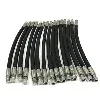
The mechanical parts of hydraulic hoses are suitable parts for connecting circuits, pumps, valves, filters, hoses, metal hoses, etc. The variety of hoses is complex, the structure is diverse, and the conditions of use are different. The length of hose life depends not only on the quality, but also on correct use and maintenance. Therefore, even if the product is of high quality, if it is not used and maintained correctly, it will seriously affect its quality and life.
In the pressurized drilling project, if the high-pressure hose used has oil surge and leakage, the following methods can be used for emergency treatment
One is the restructuring law.
Due to the different pipe joints of rubber hoses in hydraulic systems, high-pressure or ultra-high-pressure rupture hoses should not be bonded, bundled or bone-bonded. Therefore, a reorganization method can be adopted: sawing off the pipe joint of the ruptured hose; finding an alternative hose with similar pressure bearing capacity and length to the ruptured hose, sawing off its pipe joint; welding the angle of the ruptured hose joint on the replacement hose on the pipe; clean the welded hose and it is ready to use.
The second is the bone setting method.
When the rupture of the rubber hose is relatively large or is about to break due to external force (shrapnel breakdown, extrusion rupture) or system overload, the bone grafting method can be used: wipe the ruptured part of the hose clean, cut off the ruptured part; Insert it into the cut hose, and clamp the hose and the bone with a self-made steel plate clip (in an emergency, use No. 8 iron wire instead of the self-made steel plate clip); clean the connected hose and use it.
The third is the binding method.
The bundling method is suitable for emergency repair of ruptured rubber hoses with pressure below 16MPa. The specific method is to apply one of the above-mentioned rubbers commonly used in construction machinery on the ruptured part of the hose, and the oil-resistant rubber skin whose width is 2 to 3 times the length of the ruptured part is wrapped around 2 to 3 layers of the rubberized part (coating each layer), and use Oil-resistant rubber skin wrapped with 12-gauge wire
The fourth is the circuit breaker method.
In the hydraulic system of construction machinery, some oil circuits play a role in protecting the safety of the system. When the rubber hose in these oil circuits is broken, the circuit breaker method can be used; discard the protective device in the oil circuit (such as a safety valve, etc.); block the oil circuit leading to the broken hose, and disconnect the oil circuit. When using the open circuit method, the system load should be controlled between 85%-95% of the rated load.
The fifth is sticking method.
When the rubber hose with a pressure of 25-8.0 MPa in the hydraulic system is broken, the bonding method can be used: wipe around the broken hose; apply anaerobic adhesive, epoxy glue, 801 glue to the broken hose One of glue or 502 glue (the length of the coating is about 2-3 times the length of the ruptured part); use tape or canvas strips to stack 4-5 layers of the coating (each layer should be glued); The two ends of the canvas strips are knotted; it can be used after curing for 15-20 minutes.
The sixth is the transposition method.
In the hydraulic system, rubber hoses in the same oil circuit have the same specifications, but bear different oil pressures. Ruptured hoses are mostly hoses with high oil pressure. Therefore, the transposition method can be used: simple bonding or bundling of broken hoses; replacement of oil pipes at the oil inlet and outlet.
All in all, the method is an emergency method in an emergency, and the high-pressure hose will inevitably lose its original index performance. Therefore, replace after opening, and the equipment used remains in good condition. In practical application, hose rupture should be avoided, and frequent inspection and maintenance should be carried out.