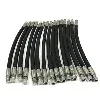
About PVC hose formulation and raw material analysis
PVC hose is made of polyvinyl chloride resin by adding a large amount of plasticizer, a certain amount of stabilizer and other auxiliaries through extrusion molding. It has the characteristics of smoothness, light weight, beautiful appearance, softness and good coloring. It is widely used in construction, chemical industry, household, water infusion, transportation of corrosive medium, and also used as wire casing and wire insulation layer.
The formulation of PVC hose mainly includes: PVC resin, heat stabilizer, lubricant, plasticizer and colorant. According to the analysis of the above technical indicators, the formula design should meet the requirements of moderate hardness and high strength.
PVC hose production process
Batching → kneading → extrusion granulation → extrusion molding → traction → coiling → packaging → quality inspection → finished product
Analysis of PVC hose composition
In order to improve the degree: when selecting processing auxiliary materials, try to choose auxiliary materials with the same or similar refractive index as that of PVC resin (1.52~1.55). Because raw materials with the same or similar refractive index are processed into a homogeneous mixture, their refractive index is also similar to that of the raw materials. In this way, the scattering phenomenon in the direction of incident light will not increase, so the turbidity of the product will not increase, and the degree of the product will not be greatly affected.
Due to the relatively large amount of plasticizer in the formula of PV, the PVC resin is required to have good oil absorption, and a loose resin should be selected. At the same time, high whiteness and good thermal stability of the resin are required. Batches with a low number of impurities and fish eyes. Under the premise of meeting the requirements of mechanical properties, the production of PVC hoses should try to use resins with a slightly lower molecular weight.
Because the commonly used plasticizers DOP and DBP often contain components with relatively low molecular weight, when the processing temperature is higher than 105 ℃, they often volatilize and form bubbles, and the temperature can only be controlled at a low level. In this case, the plasticizing and melting degree of resin with low molecular weight is higher than that of resin with large molecular weight, which is beneficial to improve the degree of product. In addition, resins with slightly lower molecular weights are also easier to process. Generally, PVC-SG3, SG4 and SG5 resins can be used, which can be selected according to product requirements.