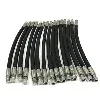
Specializing in the production of wear-resistant hoses, wear-resistant sandblasting hoses are a type of material conveying hose. It is often black, sub-yellow or transparent; most of them are wrapped with outer rubber packing tape, and it is common to have steel wires between the inner and outer rubber to apply to negative pressure conditions.
Uses: Mainly used for fluid transportation of particles, gravel, cement, quicksand, concrete, gypsum and other solid particles, suitable for various tunnel projects, wells, caverns and other engineering operations.
Structure: black smooth antistatic wear-resistant synthetic rubber inner layer, multi-layer wear-resistant tape reinforcement layer, wear-resistant outer rubber layer. Features: The rubber hose has small tolerances in inner and outer diameters, high wear resistance, and weather resistance; the product is made of antistatic rubber. In fact, the wear-resistant tube and the wear-resistant plate are the same, but one is a pipe and the other is a plate. So the principle is the same when making it. Today we are going to talk about wear-resistant pipes and wear-resistant pipes. How thick is the wear-resistant layer to meet the requirements of wear-resistant performance? The wear-resistant pipe is composed of two parts, which are ordinary seamless steel pipes and alloy wear-resistant layers. . We generally require the alloy wear-resistant layer to reach one-third to normal of the total thickness, the thin surfacing thickness is 2 mm, and the thick surfacing can be 15 mm, provided that it cannot exceed the thickness of ordinary steel pipes. For example, if the wall thickness of the steel pipe is 12 millimeters, then we can choose the thickness of the surfacing welding to be between 3 and 12 millimeters, ideally 4 to 6 millimeters. Because in use, the existence of the alloy wear-resistant layer is mainly to meet the wear-resistant performance under actual working conditions. Ordinary steel pipes are only responsible for the comprehensive performance of resisting external forces such as strength, toughness and plasticity, so the alloy wear-resistant layer is very important. of. Generally, carbon and chromium alloys are used as the only materials, and other alloy components such as manganese, molybdenum, niobium, and nickel are added at the same time, so it has strong stability at high temperatures and maintains high hardness. antioxidant properties.
So what method do we use to effectively combine the ordinary steel pipe and the alloy wear-resistant layer to exert its wear-resistant effect? In fact, the alloy wear-resistant layer of the wear-resistant pipe and the ordinary steel pipe are metallurgically combined. The inner wall of the steel pipe is used for surfacing welding equipment. After automatic welding, the high-hardness self-protecting alloy welding wire is evenly welded on the seamless steel pipe. The number of surfacing welding layers One layer to two layers or even multiple layers, finally forming a high-performance wear-resistant pipe.