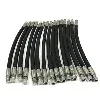
With the continuous development of the economy and society, high-pressure hoses are also widely used in all walks of life, and have become relatively common products in social industrial products. After the purchase of high-pressure hoses, safety is very important for users. Important, so how do we test the safety of high-pressure hoses?
1. Pressure test
Test the pressure of the high-pressure hose, check whether the pressure of the hose is qualified, whether the pipe body is leaking, whether the parts are damaged, etc. To determine whether the safety of the hose is good.
2. Air tightness test
The air tightness test of high-pressure steel wire wound rubber hose uses dry and clean air or nitrogen or other protective gases as the detection medium to detect whether the hose is leaking.
3. The texture of the hose is uniform.
Check whether the quality of the high-pressure steel wire wound rubber hose is uniform, and whether there are irregularities such as gluing. If so, they will be considered ineligible.
4. Deflection test
Moderately bend the high-pressure steel wire wound rubber hose to see if it has certain toughness, so as to avoid abnormal fracture caused by bending during use and affect the normal use of users.
High temperature resistant hoses mainly include hydraulic pipes and water supply and drainage pipes. Such as continuous casting machine secondary cooling, sintering machine lubrication station, blast furnace taphole machine, etc. For high-temperature and high-pressure oil pipes, we generally adopt the technology of outsourcing asbestos for engineering high-pressure oil pipes. Asbestos is made of high-temperature-resistant materials, and high-pressure hoses are pressure-resistant, oil-resistant, and corrosion-resistant, plus high-temperature-resistant technology, which has a longer service life and a wider range of applications. Asbestos hose structure: The hose is composed of an inner rubber layer, a multi-layer winding layer and an outer rubber layer, and is covered with asbestos cloth, which can withstand 300 degrees.