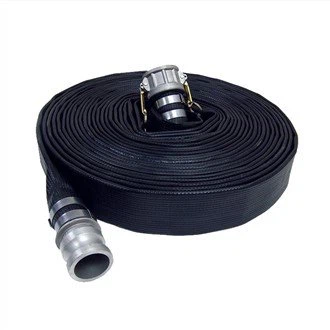
Hey there! As a supplier of PVC Spiral Hoses, I often get asked about all sorts of technical details regarding these hoses. One question that comes up quite a bit is, "What is the coefficient of friction inside a PVC spiral hose?" Well, let's dive right into it.
First off, let's talk a bit about what the coefficient of friction actually means. In simple terms, the coefficient of friction is a number that represents how much resistance there is between two surfaces when one slides over the other. When it comes to a PVC spiral hose, we're mainly interested in the friction between the fluid flowing inside the hose and the inner surface of the hose itself.
The coefficient of friction inside a PVC spiral hose can vary depending on several factors. One of the most significant factors is the smoothness of the inner surface of the hose. PVC hoses can have different levels of smoothness, and a smoother inner surface generally means a lower coefficient of friction. That's because there are fewer irregularities for the fluid to interact with as it flows through the hose.
Another factor that can affect the coefficient of friction is the type of fluid flowing through the hose. Different fluids have different viscosities, which is a measure of how thick or thin they are. For example, water has a relatively low viscosity, while honey has a high viscosity. Fluids with higher viscosities tend to have more friction with the inner surface of the hose, resulting in a higher coefficient of friction.
The temperature of the fluid can also play a role. Generally, as the temperature of a fluid increases, its viscosity decreases. This means that a warmer fluid will flow more easily through the hose, resulting in a lower coefficient of friction. On the other hand, a colder fluid will be more viscous and will have a higher coefficient of friction.
Now, let's get a bit more technical. The coefficient of friction inside a PVC spiral hose can be calculated using the Darcy - Weisbach equation, which is used to determine the head loss (or pressure drop) in a pipe or hose due to friction. The equation is:
$h_f = f \frac{L}{D} \frac{V^2}{2g}$
Where $h_f$ is the head loss due to friction, $f$ is the Darcy friction factor (which is related to the coefficient of friction), $L$ is the length of the hose, $D$ is the diameter of the hose, $V$ is the velocity of the fluid, and $g$ is the acceleration due to gravity.
To find the coefficient of friction, we need to know the Darcy friction factor. This factor can be determined using the Moody chart, which is a graph that relates the Reynolds number (a dimensionless number that describes the flow regime of the fluid) and the relative roughness of the inner surface of the hose to the Darcy friction factor.


The Reynolds number is calculated using the formula:
$Re = \frac{\rho V D}{\mu}$
Where $\rho$ is the density of the fluid, $V$ is the velocity of the fluid, $D$ is the diameter of the hose, and $\mu$ is the dynamic viscosity of the fluid.
The relative roughness is the ratio of the average height of the irregularities on the inner surface of the hose to the diameter of the hose.
As a PVC Spiral Hose supplier, we offer a wide range of hoses to suit different applications. For example, our Flexible PVC Hose Spiral Convoluted is great for applications where flexibility is key. It has a smooth inner surface, which helps to reduce the coefficient of friction and allows for efficient fluid flow.
If you need a hose for suction applications, our 6 Inch Suction Hose Pipe is a great choice. It's designed to withstand the pressures associated with suction, and its construction helps to minimize friction and ensure a steady flow of fluid.
For those in the food industry, we have the Food Grade PVC Steel Wire Hose. This hose is made from food - grade materials and has a smooth inner surface that meets strict hygiene standards. The low coefficient of friction in this hose helps to prevent the buildup of food particles and ensures a clean and efficient flow.
Understanding the coefficient of friction inside a PVC spiral hose is crucial for ensuring the efficient operation of your fluid - handling system. By choosing the right hose for your application and taking into account factors such as fluid type, temperature, and flow rate, you can minimize friction and reduce energy consumption.
If you're in the market for PVC spiral hoses and want to learn more about how the coefficient of friction can affect your application, or if you have any other questions, don't hesitate to reach out. We're here to help you find the perfect hose for your needs and ensure that your system runs smoothly.
References
- Munson, B. R., Young, D. F., & Okiishi, T. H. (2009). Fundamentals of Fluid Mechanics. John Wiley & Sons.
- White, F. M. (2011). Fluid Mechanics. McGraw - Hill.