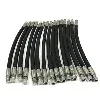
The hose assembly is a finished product including a hose and connectors at both ends. Depending on the relevant application, the hose assembly can be purchased and installed directly on the relevant equipment. According to the mouth shape of the related equipment, matching connectors and hoses need to be purchased separately and connected directly. Hose assembly components are mainly used for the transmission of hydraulic pressure, air pressure and water pressure in locomotives and mechanical equipment.
Hose assembly
What are the precautions when using the hose assembly?
1. Working pressure: the maximum pressure that can be endured for long-term stable work; this pressure value needs to be greater than or equal to the maximum pressure of the hydraulic system (pulse pressure or maximum pressure of the hydraulic system).
2. Experimental pressure: Compress at twice the working pressure for 60 seconds. There are no leaks and the pressure value drops.
3. Bursting pressure: generally refers to 4 times the working pressure value.
4. Temperature range: generally expressed as -40 ~ 100.
5. The basic model specification of the hose is identified by the inner diameter of the hose, that is, the rounded nominal path DN.
6. Hose bending radius: a small bending radius that can be selected when continuing to work under high pressure, less than the recommended bending radius will seriously affect the strength of the hose. In addition, the small straight length of the hose and hose connection transition section needs to be greater than 1.5 times the outer diameter of the hose.
7. Hose assembly arrangement: Avoid stretching, compression, torsion or acute angle friction to cause damage to the hose, and cannot be used in a twisted state.

What is the forming process of the hose assembly?
The basic processes of hose production include mixed adhesive processing, curtain and canvas processing, hose forming, vulcanization, etc. Rubber tubes with different structures and skeletons, the processing methods of the skeleton layer and the hose forming equipment are different.
Because the whole school tube has no skeleton layer, just press the hose with an extruder. The vise should use a former that wraps the tape in the inner glue. When the suction hose is formed, the metal spiral is first wrapped, and then the glue inside the bag is wrapped. Weaving and winding rubber tubing requires specialized fabric weaving or winding machines. Knitting hoses use knitting machines, etc.
The hose forming method is mainly divided into coreless and core methods (including soft core and hard core methods) according to the use of the core.
Coreless forming
The rubber tube has no core, and the equipment is an extrusion molding machine (usually a screw extruder), which is directly molded on the inner tube pressing the skeleton layer and the outer rubber layer.
The adhesive is mixed in the trachea, mixed, plasticized, tightened, moved to the direction of the machine head through the placement of the extrusion screw, and then extruded from the mold into a certain form of product. The screw extruder is divided into thermal grade fee and There are two types of cooling fees. The former feeds the preheated material through an open smelting machine, and the latter feeds the glue without the heat agent. (Albert Einstein).
Core forming
The rubber tube is core formed, which means that the rubber tube is formed on a hard core or a soft core. In order to ensure that the rubber tube is under pressure during the vulcanization process, after the rubber tube is formed, a water cloth (a roll of soaked wet cloth with a width of about 10 cm), The rope or lead is wrapped and vulcanized again.
Vulcanization can be directly heated with steam or continuous vulcanization using a vulcanization tank. Short fiber hoses directly add short fibers to rubber, and then form, the production process is simple, and gradually replace knitted hoses and clamps. Modern hose production processes tend to be highly continuous and automated. The use of thermoplastic rubber or plastic eliminates the vulcanization process and greatly simplifies the production process.