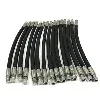
The Applications and Advantages of Hydraulic Hoses
As an essential component of hydraulic systems, hydraulic hoses have been widely used in various industries. They are flexible and durable tubes that transfer liquids under high pressure. Compared with rigid steel tubes, hydraulic hoses have significant advantages, which make them preferable in many applications.
Firstly, hydraulic hoses can be easily bend and routed to fit into complex spaces. They are made of multiple layers of synthetic rubber, reinforced with high-tensile steel wire braids or spirals. This construction provides outstanding flexibility and kink resistance, allowing the hoses to follow the movement of machinery and equipment. Hydraulic hoses can also be cut and crimped to custom lengths, which reduces installation time and costs.
Secondly, hydraulic hoses have excellent endurance under extreme temperatures, pressure, and abrasion. They are designed to operate in a wide range of conditions, from -40°C to +120°C, and withstand pressures up to 10,000 psi. The outer layer of hydraulic hoses is often covered by a protective sheath that resists punctures, cuts, and UV radiation. Moreover, hydraulic hoses can absorb shocks and vibrations, which reduces the impact on the connected components and prolongs their service life.
Thirdly, hydraulic hoses are versatile and compatible with many fluids and chemicals. They can carry water, oil, hydraulic fluids, acids, and alkalis, depending on the type of hose and the application. Hydraulic hoses are usually color-coded according to the fluid they convey, which avoids confusion and contamination. In addition, hydraulic hoses can be fitted with various end connections, such as flanges, couplings, reducers, and valves, to meet specific needs.
Lastly, hydraulic hoses enable efficient and reliable power transmission in hydraulic systems. They play a critical role in transferring energy from the pump to the actuator, such as cylinders, motors, or valves. Hydraulic hoses ensure that the pressure and flow of the hydraulic fluid are controlled and stable, which enhances the precision, speed, and safety of the machinery and equipment. Hydraulic hoses also reduce the noise and emissions generated from hydraulic systems, which benefits the environment and the operators.
In conclusion, hydraulic hoses are essential components that provide flexible, durable, versatile, and efficient solutions for fluid transfer and power transmission in many industries. Their advantages include flexibility, endurance, versatility, and compatibility. Hydraulic hoses are widely used in construction, agriculture, mining, transportation, aerospace, and other fields where hydraulic systems are applied. As technology and innovation continue to advance, hydraulic hoses are expected to evolve and enhance their performance and sustainability.
Apr 23, 2024
Leave a message
The Applications and Advantages of Hydraulic Hoses
Previous
PU Braided Hose IntroductionSend Inquiry