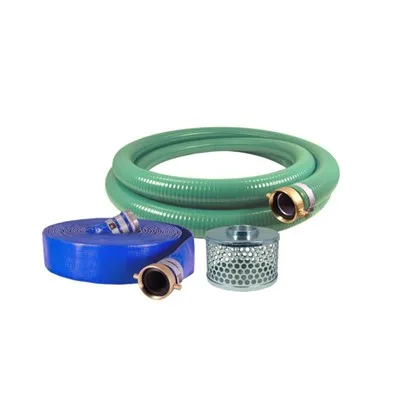
Yo, what's up! I'm a supplier of PVC spiral hoses, and today I wanna take you through the production process of these awesome hoses. PVC spiral hoses are super versatile and are used in a bunch of different industries, from agriculture to construction, and even in some home applications. So, let's dive right in and see how they're made.
Raw Material Preparation
The very first step in making PVC spiral hoses is getting the raw materials ready. PVC, or polyvinyl chloride, is the main ingredient here. It comes in the form of a powder, which is a thermoplastic material. This means it can be melted and molded into different shapes when heated and will harden when it cools down.
We also need some additives. These additives are crucial as they give the PVC hose its unique properties. For example, we add plasticizers to make the PVC more flexible. Without them, the hose would be really rigid and brittle. Stabilizers are added to prevent the PVC from degrading when it's exposed to heat, light, or chemicals during the production process and later in use.
Once we've got all the raw materials sorted, we mix them together in a high - speed mixer. This ensures that all the additives are evenly distributed throughout the PVC powder. It's like making a cake batter; you wanna make sure all the ingredients are well - combined for the best results.
Extrusion
After the raw materials are well - mixed, it's time for the extrusion process. This is where the magic really starts to happen. We feed the mixed PVC compound into an extruder. An extruder is basically a big machine with a screw inside a heated barrel.
As the screw rotates, it pushes the PVC compound forward through the barrel. The barrel is heated to a specific temperature, usually between 150 - 200 degrees Celsius, depending on the formulation of the PVC. This heat melts the PVC compound, turning it into a thick, gooey liquid.
At the end of the extruder, there's a die. The die is a specially designed tool with a hole in the shape of the inner diameter of the hose. As the melted PVC is forced through the die, it takes on the shape of the die hole, forming the inner tube of the hose. This inner tube is the core of the PVC spiral hose, and its quality is really important as it will come into contact with the fluid or gas that the hose is carrying.
Spiral Reinforcement
Once the inner tube is formed, it's time to add the spiral reinforcement. This is what gives the PVC spiral hose its strength and flexibility. The reinforcement material is usually made of a high - strength synthetic fiber or metal wire.
We use a special machine to wind the reinforcement material around the newly formed inner tube in a spiral pattern. The machine is set to control the pitch and tension of the spiral winding. The pitch determines the distance between each turn of the reinforcement, and the tension ensures that the reinforcement is tightly wrapped around the inner tube.
This spiral reinforcement not only makes the hose stronger but also helps it maintain its shape under pressure. It prevents the hose from collapsing or bursting when there's a high - pressure fluid or gas flowing through it.
Outer Layer Extrusion
After the spiral reinforcement is in place, we add an outer layer to the hose. This outer layer serves several purposes. It protects the inner tube and the reinforcement from external damage, such as abrasion, chemicals, and UV rays.
We use another extruder to apply the outer layer. Similar to the inner tube extrusion process, the PVC compound for the outer layer is melted and then extruded over the reinforced inner tube. The outer layer is carefully controlled to ensure a uniform thickness and a smooth finish.


Cooling and Sizing
Once the outer layer is applied, the newly formed PVC spiral hose needs to be cooled down quickly to solidify the PVC. We usually use a water cooling tank for this purpose. The hose is passed through the tank filled with cold water, which rapidly cools it down.
After cooling, the hose goes through a sizing process. This is to make sure that the hose has the correct outer diameter and wall thickness. The sizing usually involves passing the hose through a series of sizing dies and rollers, which gently shape and compress the hose to the desired dimensions.
Cutting and Testing
The next step is cutting the long continuous hose into the desired lengths. We use a cutting machine that can make precise cuts according to the customer's specifications.
Before the hoses are ready to be shipped out, we conduct a series of tests to ensure their quality. We check for things like pressure resistance, leakage, and flexibility. For example, we might subject the hoses to high - pressure water or air to see if they can withstand the pressure without bursting or leaking. If a hose fails any of these tests, it's rejected and sent back for further inspection or recycling.
Packaging
Once the hoses pass all the tests, it's time for packaging. We typically use plastic bags or cardboard boxes to package the hoses. The packaging not only protects the hoses during transportation but also makes it easier to store and handle them.
Now, if you're in the market for PVC spiral hoses, we've got a great range of products to offer. Check out our 1.5 Inch Water Hose, which is perfect for small - scale water transfer applications. If you need something bigger, our 3 Inch Water Pump Hose is a great choice for high - volume water pumping. And for spa and pool applications, our 2 Inch Spa Flex Hose is flexible and durable.
If you're interested in any of our PVC spiral hoses or have any questions, don't hesitate to reach out. We're always happy to have a chat and discuss your specific needs. Whether you're a small business or a large industrial client, we can provide you with the right hoses at a competitive price.
References
- "Plastic Extrusion Technology Handbook"
- "Polyvinyl Chloride (PVC): Properties, Processing and Applications"