What is the weight of steel fittings? This is a question that often comes up in various industrial and construction projects. As a seasoned steel fitting supplier, I've encountered this query numerous times from clients across different sectors. Understanding the weight of steel fittings is crucial for multiple reasons, including transportation planning, structural design, and cost estimation. In this blog post, I'll delve into the factors that influence the weight of steel fittings and provide some practical insights.
Factors Affecting the Weight of Steel Fittings
Material Composition
The type of steel used in the fittings plays a significant role in determining their weight. There are different grades of steel, such as carbon steel, stainless steel, and alloy steel. Carbon steel is a common choice due to its affordability and good strength properties. It typically has a relatively high carbon content, which gives it a certain density. Stainless steel, on the other hand, contains chromium and other elements that enhance its corrosion resistance. The addition of these elements can increase the density of the steel to some extent. Alloy steel is made by adding other elements like nickel, manganese, or vanadium to improve specific properties such as hardness or toughness. Each type of steel has its own unique density, which directly impacts the weight of the fittings.
Size and Dimensions
The physical size and dimensions of the steel fittings are obvious factors that affect their weight. Larger fittings generally weigh more than smaller ones. For example, a large - diameter pipe fitting will be heavier than a small - diameter one of the same type. The wall thickness also matters. A fitting with a thicker wall will have more material and thus weigh more than a similar - sized fitting with a thinner wall. Consider a Steel Air Line Fittings. If it has a larger inner diameter and a thicker wall, it will have a greater weight compared to a smaller and thinner - walled one.
Design Complexity
The design of the steel fitting can also influence its weight. Fittings with complex shapes, such as those with multiple bends, flanges, or intricate patterns, may require more material during the manufacturing process. For instance, a Carbon Steel Pipe Fittings Elbow with a sharp bend and additional reinforcement features will weigh more than a simple straight pipe section. The extra material used to create these complex features adds to the overall weight of the fitting.
Calculating the Weight of Steel Fittings
To calculate the weight of steel fittings, we usually rely on the density of the steel and the volume of the fitting. The density of steel is typically around 7850 kg/m³, but this can vary slightly depending on the exact composition. The volume of the fitting can be calculated using geometric formulas. For simple shapes like cylinders (such as pipes), the volume formula is V = πr²h, where r is the radius and h is the height or length of the cylinder. For more complex shapes, we may need to break the fitting down into smaller, more manageable geometric components and calculate the volume of each part separately before summing them up.
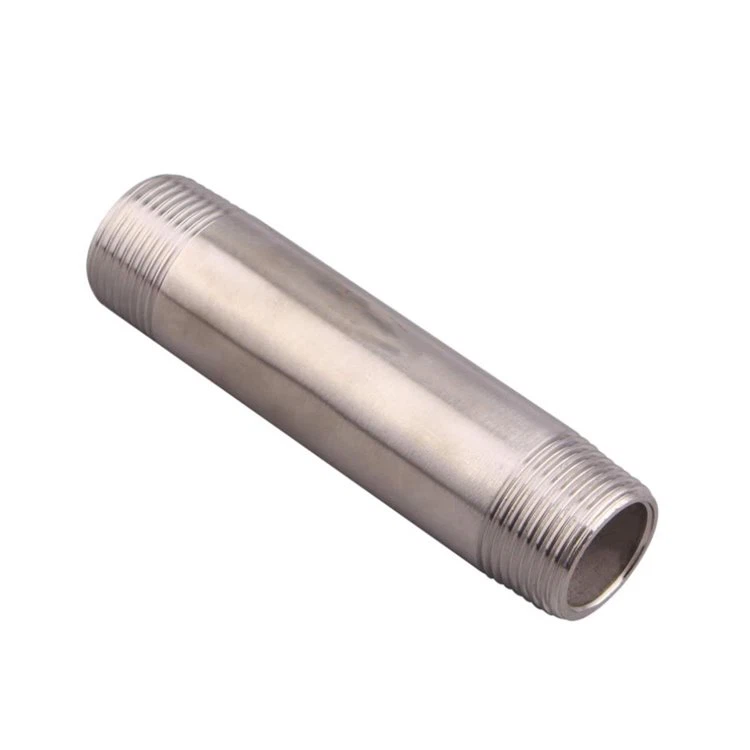

Let's take a Stainless Steel Pipe Fittings Swage Nipple as an example. Suppose it has a larger end with a radius of r1, a smaller end with a radius of r2, and a length of L. We can approximate its volume by considering it as a frustum of a cone. The volume formula for a frustum of a cone is V = (1/3)πh(R² + r²+ Rr), where R is the radius of the larger base, r is the radius of the smaller base, and h is the height. Once we have the volume, we can multiply it by the density of stainless steel to get the weight.
Importance of Knowing the Weight of Steel Fittings
Transportation
Knowing the weight of steel fittings is essential for transportation planning. Trucks, trains, and ships have weight limits, and overloading can lead to safety hazards and legal issues. By accurately calculating the weight of the fittings, we can ensure that the transportation is carried out efficiently and safely. It also helps in determining the shipping costs, as many carriers charge based on weight.
Structural Design
In construction and engineering projects, the weight of steel fittings is a critical factor in structural design. The load - bearing capacity of a structure needs to be carefully calculated to ensure its stability. If the weight of the fittings is underestimated, the structure may not be able to support the load, leading to potential failures. On the other hand, overestimating the weight can result in an over - designed and more expensive structure.
Cost Estimation
The weight of steel fittings is directly related to their cost. Steel is typically sold by weight, so the heavier the fitting, the more it will cost. By knowing the weight, clients can accurately estimate the cost of their projects and budget accordingly. It also allows them to compare the costs of different fittings and make informed purchasing decisions.
Our Offerings as a Steel Fitting Supplier
As a steel fitting supplier, we understand the importance of providing accurate weight information to our clients. We have a wide range of steel fittings, including Steel Air Line Fittings, Stainless Steel Pipe Fittings Swage Nipple, and Carbon Steel Pipe Fittings Elbow. Our team of experts can assist you in calculating the weight of the fittings you need for your specific project. We ensure that all our products are manufactured to high - quality standards, and we can provide detailed specifications, including weight, for each fitting.
If you're in the process of planning a project that requires steel fittings, we encourage you to reach out to us. Whether you need help with weight calculations, cost estimation, or product selection, our team is here to assist you. We pride ourselves on offering reliable products and excellent customer service. Contact us today to start the procurement process and let us help you find the perfect steel fittings for your needs.
References
- Steel Construction Manual, American Institute of Steel Construction
- Handbook of Steel Fittings Design and Applications, Industry Press